Value Added Tax

Dhruva Consultants GCC VAT Implementation Support

VAT Registration, Consulting & Advisory Services

As they say, any strategy, even a great one, doesn’t implement itself. Implementation is a challenging and onerous activity. We believe that implementation should be impeccable and flawless so that business can continue to function smoothly during and post implementation.

What we do?

  • Impact Assessment : Mapping VAT impact for the transactions undertaken by the businesses including impact on various business functions
  • Registrations : Assistance in applying for VAT registration
  • IT System review : IT system reflects the output of the VAT implementation project. We undertake gap analysis to identify changes required at Master and transactional level as well as conducting User Acceptance Test (UAT) to ensure system readiness
  • Transition management : Handholding to ensure successful transition to VAT regime
  • Hypercare support : The intent and conception behind Hypercare support is to enable businesses to focus on their core operations while leaving the functional aspects of VAT with the VAT expert to ensure compliance and smooth transition to the tax regime
  • Project Manager : Dedicated Project manager to spearhead the implementation project and constantly liaise with the client
  • Representation : Identifying areas which require Representation to the Tax Authorities and providing assistance in filing the same.

Technical and functional Trainings

Dissemination of salient aspects of VAT among all stakeholders is a crucial part as it has to be followed and implemented correctly by all the stakeholders. Training sessions are intended to provide information and training on VAT aspects in relation to all key constituents of a business. Topics are covered in comprehensive, yet compact modules that are bifurcated into the following four parts:

  • Beginner VAT awareness sessions on the generic aspects of VAT
  • Functional awareness sessions for understanding impact on key business functions;
  • Training for understanding compliances and reporting requirements
  • Awareness session for entity’s vendors and customers to bring them onboard VAT for tax compliant transactions.

Developing Standard Operating Procedures (SOPs)

Processes enables an employee to execute a task in defined and structured manner. Most of the day-to-day activities managed by the employee are process driven. Since, VAT is a transaction-based tax it is imperative to analyse and align each step of the process with the provisions of VAT Law so as to ensure there are no gaps in compliance. We undertake following key steps to identify potential areas of VAT impact:

  • Discussing with Head of Departments (HODs) to understand end-to-end process
  • Review of documentation trail for the entire process
  • Suggesting areas of VAT impact in terms of changes in roles and responsibilities as well as documentation changes.

GCC VAT compliance support

We assist companies in preparation, review and filing of VAT return across the GCC countries which involves the following key steps:

  • Review of sales and purchase registers along with sales and purchase invoices
  • Review of financial information
  • Review of documents, invoices, agreements, etc.
  • Review of VAT return workings prepared by the Company
  • Providing assistance in finalizing VAT return workings
  • Assistance in filing VAT return.

VAT Advisory

We assist companies by managing the queries raised during and post VAT implementation and would undertake the following:

  • Providing advice on ongoing matters with respect to the Company’s VAT obligations, including tax position to be adopted, tax risks, documentation, records to be maintained, etc.
  • Ascertaining the impact on the tax updates / developments, on the tax position taken by the Companies
  • Assisting Companies in filing Reconsideration to challenge to decision issued by the Authorities
  • Assistance in representing Companies before Resolution Committee, Courts, etc.

Filing Clarification / Ruling applications

  • Advising Companies on matters which are complex / unclear on which position has not evolved
  • Undertaking technical research including research in other tax jurisdictions
  • Providing assistance in drafting and submitting Clarifications / Ruling request with the Authorities.

VAT Audit support

  • Providing pre-audit, during audit and post audit support to Companies in form transaction advisory, documentation support, etc.
  • Highlighting risks, areas of exposure / non-compliance during pre-audit and audit phase
  • Advising on way-forward post completion of Audit by the authorities.

Refund Assistance

Refund of VAT is a scenario where input tax amount is higher than output tax amount as per the tax return filed with the tax authority. Typically refund claim is scrutinised by the tax authority before sanctioning the refund claim. We assist in undertaking the following:

  • Advising whether refund application should be filed or excess input tax should be carried forward to subsequent tax return
  • Preparation of refund application and assistance in submission (including review of refund related documents)
  • Assisting in replying to queries raised by the Authorities prior to sanctioning the claim.

VAT Review

It is obligation of every person to abide with the Law of the Land. Typically, it can be observed that any new implementation requires retesting on timely basis to monitor its functionality. Similarly, it is very crucial for all organisations to ensure whether it has been correctly following with the provisions of the VAT, Excise regulations (if applicable) governing the organisation. Accordingly, a thorough examination is required to identify gaps, reason of occurrence, its ramification and corrective measures to be undertaken to avoid its reoccurrence. We undertake the following key steps:

  • Review of all business transactions and corresponding tax policy;
  • Review of all processes (for e.g. AR/ AP) and recommending changes thereof;
  • Review of reports configured and identification of any additional requirement;
  • Documentation review for e.g. contract review, invoices review, etc.

Deputation/ VAT Function Outsourcing

Taxation is a branch of knowledge which requires specific educational background along with domain specific experience. Accordingly, basis the scale of operations a tax team or tax expert is required to manage governance and compliance. We can assist companies by providing tax specialists (i.e. outsourcing, co-sourcing, deputation, etc.) so that the company has to only focus on business while tax compliances are handled by experts.

Excise Tax

Dhruva Consultants Excise Tax Registration, Return & Legal Services

We provide support in evaluating implications of Excise / Selective Tax on the business operations including ascertaining whether product is subject to Excise / Selective Tax, impact on valuation for levy of tax, ascertaining rate of tax, etc.

We also assist in applying for Excise / Selective tax registrations, undertaking periodic compliances, conducting excise training, assist in filing of excise tax declarations, assist in filing of clarification, etc.

Customs

Global enterprises require global supply chains. From a customs point of view, managing these supply chains is a tremendous task as customs laws and trade regulations on a national level are not internationally harmonized.

At Dhruva Consultants, our team can help you manage customs compliances and find tailor-made solutions for structuring your supply chain in a tax-efficient and sustainable manner.

Dhruva Consultants offers a wide range of customs services which include:

Compliance

  • Assistance with customs registrations and trade subscriptions
  • Assistance with periodic compliance and the maintenance of records
  • Preparing Standard Operating Procedures (SOPs) for mapping customs processes and procedures that are specific to an industry and/or business model
  • Assistance with obtaining customs clearance certificates
  • Assistance with obtaining exit certificates for exports
  • Assistance with obtaining customs duty refunds

Advisory

  • Advise relating to specific customs issues, tariff classifications, and valuations
  • Conducting customs compliance awareness and training
  • Advise relating to alignment of customs valuations and transfer pricing policies
  • Assistance in obtaining advance rulings on specific issues requiring clarification
  • Assistance incompliance relating to customs facilities, such as consolidated declarations, Authorized Economic Operator (AEO) status, and the World Logistics Passport (WLP).

Audit & Litigation Support

  • Assistance in preparing reconciliation of inbound, consumed, and outbound declarations and audit submissions
  • Handholding during customs audits initiated by the customs authorities
  • Liaising with the customs authorities
  • Assistance in application for conciliatory settlement with Dubai Customs for penalty waiver
  • Assistance in filing grievances and appeals

UAE Corporate Tax

Dhruva Consultants UAE Corporate Tax (UAE CT) Implementation Support Services

In a significant development in the UAE, on January 31, 2022, the Ministry of Finance (MoF) announced the introduction of a Corporate Tax in the UAE effective from financials years starting June 01, 2023.

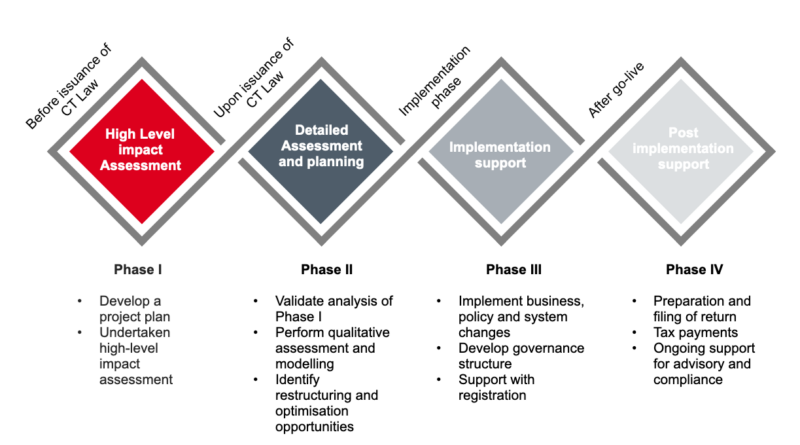
Given the announcement of the new law, we believe that implementation should be well planned and thought out so that business can continue to function smoothly during and post implementation.

What we do?

  • Impact Assessment : High level assessment of the applicability of the CT regime on in-scope and exempt entities
  • Detailed Assessment : Conduct detailed impact assessment on business based on final CT and TP regulations, review pricing of inter-company transactions and policies and highlight potential uncertain tax and TP positions.

CT implementation

  • Assistance in implementing Tax and TP policies and advising on structural changes to incorporate tax function.
  • Evaluate and advise on system readiness
  • Assistance in obtaining CT registration (individual or group)

UAE CT compliance

  • Assistance in preparation of CT return
  • Assistance in filing of CT return electronically
  • Assisting in preparation of TP local file
  • Evaluate arm’s length pricing of inter-company transactions

Our Approach

Technical And Functional Trainings

Dissemination of salient aspects of CT among all stakeholders is a crucial part as it must be followed and implemented correctly by all the stakeholders. Training sessions are intended to provide information and training on CT aspects in relation to all key constituents of a business.

Corporate Tax Advisory

We can assist companies by managing the queries raised, during and post CT implementation and assist in the following:

  • Update on the evolving tax landscape in the UAE with respect to the UAE CT
  • Advise on development of efficient tax strategies and policies
  • High-level advice on the arm’s length nature of the new inter-company transactions in line with the OECD Guidelines and UAE CT/TP law

International Tax

Dhruva Consultants International Taxation Services

With increased focus of tax authorities globally on BEPS implementation measures, disclosure norms (DAC6, CBC reporting) and the focus on taxation of digital business models, it has become practically difficult for multinational companies to determine and monitor the ever-evolving tax rules that apply during all phases of a cross-border project or activity. Tax regulations as well as administrative obligations and cost that may be relevant for a project, whether short-term or long term, need to be taken into account and examined in the offer phase for such project due to the impact they could have on the structure and execution of the project.

Entities need to have an agile tax strategy in line with their corporate goals in order to have a global competitive edge in today’s market. This includes having robust policies for cross border operations, local statutory/reporting requirements and planning of applicable effective tax rate to achieve efficiencies adherent to a company’s risk profile.

We assist with the determination of the tax consequences and other impacts for cross-border projects. We further help our clients structure their activities in the most efficient way to minimize tax expenses and risk exposure. We advise clients in identifying the relevant tax factors beforehand and include them into their project calculations. Subsequently, further support may be required in contract negotiations or contract reviews pertaining to tax
clauses and other tax relevant aspects of contracts may be given.

Some concerns company management might have in relation to a cross-border project or activity:

  • How should they structure operating companies and where should the holding company be located (considering, tax efficiencies achieved, sustainable structure and future foreign investor attractiveness)?
  • What are the tax residency rules and substance requirements in a particular jurisdiction?
  • Are there any risks of creating a deemed permanent establishment in a jurisdiction?
  • What are the tax costs and benefits of entering into a new market?
  • What are the tax, accounting and regulatory requirements?
  • How should operations be financed in tax efficient way?
  • Are there any tax incentives available if the operations are established in a particular jurisdiction?
  • What is the impact to the effective global tax rate considering a foreign subsidiary’s local income tax, foreign withholding taxes and the foreign tax credit in home country?

How can we help?

Dhruva Consultants team of tax professionals have advised clients on the following areas
to help navigate the complex global tax environment

  • Managing complexities of multiple tax systems and regulations
  • Country and permanent establishment analysis
  • International group restructuring
  • Coordination of international tax reporting and global compliance management
  • Group tax health checks
  • Global capital structure planning, including efficient cross-border finance, repatriation and cash access planning
  • Withholding tax implications for cross border transactions
  • Entry/Exit strategies
  • Transfer pricing planning and documentation support

KSA Corporate Tax and Zakat

Dhruva Consultants provides comprehensive range of services in tax and zakat function. We provide practical solutions on corporate tax and zakat issues to help our clients meet management objectives and thus, help in managing the costs associated with tax / zakat management function. We offer following services to our clients:

Tax / zakat compliance support

We assist companies in preparation, review and filing of tax / zakat declaration in the region which involves the following key steps:

  • Coordinate with your team in preparing tax / zakat declaration including detailed schedules required in support thereof;
  • Assist in certifying the tax declaration in case where taxable revenue exceeds the prescribed threshold of SAR 1 million;
  • Translate the tax / zakat return and schedules into Arabic;
  • Complete tax / zakat return into ERAD system;
  • Assistance in submitting tax / zakat return into ERAD system;
  • Advice with respect to quarterly advance tax payments;
  • Assistance in filing “Contract Information Form”.

 Tax / zakat advisory

We provide wide range of tax / zakat advisory services that will include:

  • Advising Companies to structure its business in a tax / zakat efficient and compliant manner;
  • Assist Companies in framing their contracts in compliance with tax policies;
  • Ascertaining the impact of new tax / zakat matters that pertain to clients’ business;
  • Assist the Company in health check.

Withholding tax consultation and compliance support

  • Review of contracts and advise on withholding tax implications;
  • Assist in preparing monthly and annual withholding tax return;
  • Assistance in submitting the withholding return into ERAD system.

Tax / zakat representation before the General Authority of Zakat & Tax (‘GAZT’)

  • Assist the Company in the field inspections;
  • Assist the Company in review, prepare, translate and file response to the GAZT queries including review of the supporting documents;
  • Follow-up and obtain the final assessment;
  • Assisting and advising on assessments, objections and appeals process and results.

Transfer Pricing

Dhruva Consultants Transfer Pricing Advisory Services

In today’s rapidly changing transfer pricing landscape, having an effective approach to managing transfer pricing opportunities, compliance and risk has never been more important.

Following OECD’s BEPS Action Plans, Transfer Pricing is now a big focus in the region especially with introduction of detailed transfer pricing regulations issued in the Kingdom of Saudi Arabia and Egypt. Further, groups headquartered in the region, need to keep pace with the rapidly evolving transfer pricing landscape in other jurisdictions housing their group entities/ business presence, particularly in light of Country by Country reporting and notification requirements emerging in various countries as they join and implement their commitment to the BEPS Inclusive Framework.

The changing regulatory environment precipitated by the BEPS initiative creates both opportunities and risks. With an extensive global network of leading transfer pricing practitioners, Dhruva Consultants is uniquely positioned to advise multinational companies on how to build, optimise, monitor, and defend their transfer pricing policies in a “post-BEPS” world.

What we do?

Transfer Pricing Risk assessment

Not all intra-group transactions are undertaken with a view to avoiding payment of taxes. We help MNEs manage their transfer pricing risks, strengthening their TP documentation and obtain greater assurance regarding their tax and transfer pricing positions in compliance with internationally accepted transfer pricing principles and local Transfer Pricing laws.

Transfer Pricing Planning

We help clients in developing and implementing transfer pricing policies for their proposed and existing intra-group transactions, document policies and outcomes which would help meet business and commercial objectives and at the same time reduce the risk of adjustments and penalties by tax authorities during audits. This includes:

  • Developing the most optimum transfer pricing methodology for inter-company transactions
  • Undertaking appropriate benchmarking studies to arrive at arm’s length price
  • Developing the transfer pricing policy document to document the pricing mechanism
  • Review of inter-company agreements from a transfer pricing perspective
  • Supporting clients in implementation of transfer pricing policies and undertake periodic reviews to identify any gaps.

Transfer Pricing Documentation

A robust and comprehensive transfer pricing documentation is the first step and serves as the first line of defense when tax authorities challenge a company’s transfer pricing practices.

We help clients in meeting local and global Transfer Pricing documentation requirements. This includes:

  • Local File/ Local Transfer Pricing documentation preparation in line with the requirements as per the local transfer pricing laws and the experience gained during Income Tax/ Transfer Pricing Audits
  • Master File preparation in line with the requirements as per the local transfer pricing laws and aligned with OECD requirements
  • Country by Country reporting, meeting notification requirements and assessing the exposure and transfer pricing risk for clients on account of submission of such data relating to global operations to tax authorities in different jurisdictions in which the multinational group operates.

Transfer Pricing advisory services

We assist clients in meeting their business objectives and advise them on their specific queries and pressure points including the following:

  • Alignment of transfer pricing policies with commercial objectives
  • Review existing inter-company arrangements and assess whether any tax efficiencies may be built into the documentation
  • Supply chain transformation to ensure that transfer prices are in line with value creation
  • Profit attribution to Permanent Establishments

Tax Technology & E-invoicing

Our dedicated tax technology team

At Dhruva, our multidisciplinary tax technology and e-invoicing team provides comprehensive e- services to businesses across the GCC. Our expertise encompasses implementation, vendor selection, analytics, and automation solutions tailored to meet the unique needs of our clients. We also offer strategic advisory services to software vendors on product development and go-to-market strategies. In collaboration with other service lines within Dhruva, we leverage data and emerging technologies to enhance efficiency and deliver greater value.

What We Do

Through our in-house talent and best-in-class partnerships, we offer a wide range of services:

  • Tax change preparedness: Assisting businesses in adapting to meet evolving tax regulations and requirements.
  • Vendor selection: Guiding clients in choosing the most suitable technology vendors for their specific needs.
  • Technology implementation, project management, and governance: Managing the end-to-end implementation of tax technology solutions, ensuring timely delivery and adherence to best practices.
  • Tax function analytics and control framework design and implementation: Developing analytics tools and control frameworks to enhance the efficiency and effectiveness of tax functions.
  • Bespoke solution development: Creating customised solutions, including software development, analytics, AI, and integration services tailored to client requirements.
  • Analytics and AI training: Providing training programs to equip teams with essential skills in analytics and artificial intelligence.

Our Team and Partnerships

We collaborate with leading software vendors and specialist consultants to deliver cutting-edge solutions. Our tax technology team comprises professionals with extensive accounting and tax experience, holding certifications including from ICAI and ICAEW. They bring technical expertise in areas like AI, data transformation, integration, web development, and IT architecture. Experienced in change management processes and methodologies, our team works closely with in-house tax experts across various domains, including transfer pricing, corporate tax, e-invoicing, indirect taxes, customs, and ESR.

Awards and Accolades:

  • FTA Hackathon 2024 Finalist (second place)
  • Lexis Nexis Middle East 2024 AI Legal Innovator of the Year Finalist

UAE R&D Tax Credits

Executive Summary

The UAE Ministry of Finance has issued Ministerial Decision No. 24 of 2026 (dated 18 March 2026), providing the detailed implementation rules for the R&D Tax Credit regime established under Cabinet Decision No. 215 of 2025. This is a landmark development for the UAE’s innovation ecosystem and represents the first comprehensive R&D incentive under the Corporate Tax framework.

The regime operates on a tiered, progressive credit structure with rates ranging from 15% to 50% depending on qualifying expenditure levels and R&D headcount. It applies to Tax Periods and Fiscal Years commencing on or after 1 January 2026, with first claims expected in 2027.

Critical Notice for Businesses
The regime incorporates mandatory pre-approval from the Council a gating condition with no exceptions. No pre-approval means no credit, regardless of whether underlying activities and expenditure otherwise qualify. Taxpayers with active or planned R&D operations should treat this as a priority compliance and planning matter

What is the UAE R&D Tax Credit?

The R&D Tax Credit is an expenditure-based incentive under the UAE Corporate Tax framework.
Unlike a deduction, it operates as a direct credit against Corporate Tax and/or Top-up Tax liability.
Key parameters:

  • Credit rates range from 15% to 50% on qualifying R&D expenditure, applied progressively
  • The credit is non-refundable it may only be utilised against Corporate Tax and/or Top-up Tax liability
  • Qualifying expenditure is capped at AED 5 million per Qualifying Entity or Tax Group per Tax Period
  • Applies to financial years beginning on or after 1 January 2026
  • First claims are expected to be filed in 2027

Important Update from Earlier Expectations
Earlier market commentary anticipated the credit might be refundable. The Ministerial Decision confirms it is non-refundable. This is a material distinction: early-stage businesses or that pre-profit will not receive cash back and must have Corporate Tax or Top-up Tax liability to benefit.

Credit Rates and Dual-Threshold Structure

The credit operates on a progressive, tiered basis. Qualifying Entities or Tax Groups must satisfy both a qualifying expenditure threshold AND a minimum average R&D staff headcount to access each credit tier:

Maximum Qualifying R&D Expenditure (AED) Minimum Average R&D Staff Credit Rate
First AED 1 million At least 2 15%
AED 1m to AED 2 million At least 6 35%
AED 2m to AED 5 million At least 14 50%

If a taxpayer meets the expenditure threshold for a particular tier but not the staff threshold, the credit rate is adjusted downward to the highest tier where both conditions are satisfied

Illustrative Calculation

The following example demonstrates the progressive calculation for an entity with AED 3.5 million of qualifying expenditure and 14 or more average R&D staff:

Expenditure Tier Qualifying Spend (AED) Credit Rate Credit Amount (AED)
First AED 1 million 1,000,000 15% 150,000
AED 1 million to AED 2 million 1,000,000 35% 350,000
AED 2 million to AED 5 million 1,500,000 50% 750,000
Total 3,500,000 1,250,000

In this example, the effective blended credit rate is approximately 35.7% of total qualifying expenditure, yielding a credit of AED 1,250,000 against Corporate Tax and/or Top-up Tax liability

What Qualifies as R&D?

An activity conducted in the UAE as part of an R&D Project qualifies where it meets all five criteria drawn from the OECD Frascati Manual:

  • Novel aims to produce new findings
  • Creative involves original concepts or hypotheses
  • Uncertain the outcome or means of achieving it are not known in advance
  • Systematic follows a plan and budget
  • Transferable/Reproducible results can be applied or replicated in other contexts

The following do not qualify:

  • R&D activities in social sciences, humanities, and the arts
  • Routine upgrades, aesthetic changes, standard market research, or quality control testing
  • Any R&D conducted outside the UAE only the in-State portion qualifies

Qualifying R&D Expenditure

The Decision defines three categories of qualifying expenditure, each with specific conditions and exclusions:

Category What Qualifies Key Conditions / Exclusions
Staff Costs Salaries, wages, allowances, medical insurance, pension, gratuity, bonuses, benefits in kind, and training costs for R&D staff. A 30% overhead uplift applies automatically. Staff must be in the UAE when performing R&D. Must be under entity’s supervision and control. ESOPs excluded. Intra-Tax Group recharges excluded.
Consumable Costs Materials consumed in R&D (water, fuel, power), non-capital licence fees, clinical trial payments. Must be directly used and no longer usable post-R&D. Items sold in ordinary course excluded. Intra-Tax Group purchases excluded.
Subcontracting Fees Fees paid to UAE-based subcontractors for R&D work performed in the UAE. No sub-subcontracting. Not attributable to a Foreign PE. Related party subcontractors need audited financials. Intra-Tax Group excluded.

The 30% Staff Cost Uplift
The automatic 30% uplift on staff costs to account for overheads is a meaningful benefit. It effectively increases the qualifying expenditure base without requiring separate tracking or substantiation of actual overhead allocations. For R&D-intensive businesses where staff costs dominate the expenditure profile, this uplift can materially improve the overall credit quantum.

Cost Contribution Arrangements (CCAs)

Where a Qualifying Entity participates in a CCA for joint R&D, its qualifying expenditure is the portion of its contribution determined at arm’s length and corresponding to its expected share of benefits.
Only the portion attributable to R&D carried out within the UAE qualifies. Transfer pricing documentation is essential for CCA participants.

Mandatory Pre-Approval

This is a Hard Gating Condition
Pre-approval from the Council is mandatory for every R&D Project for which the credit is claimed. The Council may also require ongoing progress updates with technical documentation. Late or incomplete applications risk disqualification regardless of the merits of the underlying R&D.

Unlike many international R&D incentive schemes that operate on a self-assessment basis with postfiling review, the UAE has adopted a gatekeeping model. Businesses should treat pre-approval preparation with the same rigour as a ruling application, including:

  • Detailed project descriptions with clear articulation of each Frascati criterion
  • Expenditure projections broken down by category
  • R&D staffing plans with headcount projections
  • Evidence of UAE-based activity and oversight

Record-Keeping Requirements

Qualifying Entities must maintain comprehensive technical documentation for seven years following the end of the relevant Tax Period or Fiscal Year. Records must be written, visual, and electronic and must cover:

  • Project objectives and scientific/technical hypotheses
  • Methodologies, processes, and experimental design
  • Experiment records and findings
  • Expenditure tracking and cost attribution to R&D activities
  • Evidence that activities were conducted in the UAE

The Council may request progress updates and technical documentation at any time, not only at the point of filing. Documentation must be created contemporaneously retrospective documentation is difficult to defend.

Commercial Significance

The R&D Tax Credit can materially change the economics of innovation investment. For an entity spending AED 3.5 million on qualifying R&D with sufficient headcount, the credit can reach AED 1.25 million an effective reduction in R&D costs of 35.7%.

Who should be prioritising this now:

  • Technology and digital platform businesses investing in product development
  • AI, biotech, and advanced manufacturing companies
  • Free zone innovation hubs and R&D centres
  • Multinationals establishing regional R&D operations in the UAE
  • SMEs with systematic development programmes

A Note for Early-Stage Companies
The non-refundable nature of the credit means pre-profit or loss-making businesses will not receive cash back and cannot immediately benefit. The carry-forward mechanism provides some relief, but ownership continuity requirements and the five-year exit claw-back constrain utility for companies undergoing rapid growth, fundraising, or restructuring.

Dhruva Perspective: Key Practical Considerations

The Dual-Threshold Design Demands Workforce Planning

The minimum R&D staff requirements (2, 6, and 14 for successive tiers) create material cliff-edge effects. An entity spending AED 4 million on qualifying R&D but employing only 5 average R&D staff would be limited to the 15% rate on the first AED 1 million only, forgoing significant credit at higher tiers. R&D workforce strategy is now an integral part of tax planning in the UAE for the first time.

Businesses should model scenarios that optimise the interplay between expenditure levels and headcount thresholds. In some cases, the marginal cost of additional R&D hires may be more than offset by the incremental credit benefit. Externally provided workers can count toward the threshold, but only where they meet detailed conditions careful contract structuring is required.

Pre-Approval Is a Strategic Imperative, Not an Administrative Formality

Businesses should treat pre-approval preparation with the same rigour as a formal ruling application. Late or incomplete applications risk disqualification regardless of the merits of the underlying R&D. We recommend beginning preparation immediately, even before formal Council guidance is published.

Intra-Group Transactions Require Careful Structuring

The Decision consistently excludes intra-Tax Group transactions from qualifying expenditure whether staff cost recharges, consumable purchases, or subcontracting fees between group members. Groups with centralised R&D functions that recharge costs to operating entities will need to review their transfer pricing arrangements and ensure qualifying expenditure is correctly identified and attributed.

Interaction with Pillar Two / DMTT Adds Complexity

The credit’s application against Top-up Tax liability for Domestic Groups introduces an additional layer of complexity for large multinationals. The ordering rule Corporate Tax first, then Top-up Tax must be carefully modelled, particularly for groups where the effective tax rate is close to the 15% minimum.
The interplay between Qualified Refundable Tax Credits under GloBE rules and the UAE’s nonrefundable R&D Tax Credit will require bespoke analysis.

How Dhruva Can Assist

As the UAE’s leading tax-exclusive advisory firm and a Ryan company, Dhruva is uniquely positioned to support businesses across the full lifecycle of R&D Tax Credit planning, compliance, and defence:

  1. R&D Activity Assessment: Technical review of your R&D portfolio against the Frascati Manual criteria to identify qualifying activities and quantify the credit opportunity.
  2. Pre-Approval Support: Preparation and submission of comprehensive pre-approval applications to the Council, including project descriptions, expenditure projections, and staffing plans.
  3. Expenditure Quantification: Detailed analysis of staff costs (including uplift calculations), consumables, subcontracting fees, and CCA contributions to maximise qualifying expenditure.
  4. Group Structuring Advisory: Optimisation of Tax Group and Domestic Group credit utilisation, transfer mechanisms, and ordering rules to maximise the benefit across the group.
  5. Transfer Pricing for CCAs: Ensuring arm’s length allocation of contributions and expected benefits under Cost Contribution Arrangements.
  6. Documentation Frameworks: Design and implementation of ongoing R&D documentation protocols that meet the seven-year compliance standard.
  7. Pillar Two / DMTT Integration: Modelling the interaction between R&D Tax Credits and Topup Tax obligations for Domestic Groups within the scope of the GloBE rules.
  8. Claw-Back Risk Assessment: Scenario analysis for restructuring, redomiciliation, Free Zone election, or ownership change scenarios to avoid inadvertent claw-back triggers

Get in Touch

Please reach out to Farid Jumah or contact your Dhruva relationship partner to explore your R&D eligibility and readiness.


Company Formation

Dhruva Consultants Setting Up Services

Foreign investments could be made in either the Mainland UAE or in any of the 45+ free zones spread strategically across the state. While a Mainland UAE set-up allows you to cater the local market, it restricts the foreign ownership to 49% (remaining 51% shares need to be held by a GCC national). However, the recent introduction of the foreign direct investment law (‘FDI law’) allows 100% foreign ownership in certain sectors subject to some criteria’.

On the other hand, free zones already extend 100% foreign ownership with specific distinct regulations, incentives and costs across different free zones. Certain free zones promote sector specific investments while others are designated for VAT exemptions.

What we do?

  • Assist in getting a local presence through a structure that achieves a company’s business goals and is in compliance with local regulations.
  • Evaluate the feasibility of setting up a Mainland UAE Branch / Mainland UAE LLC / FZ branch / FZ Company to undertake the proposed activities.
  • Analyze different investment zones and corresponding requirements, providing different options for companies to choose from. It is highly recommended to carry out a feasibility study/analysis prior to proceeding with the registration process in order to identify the most suitable investment zone depending on the requirements of the company.
  • Registering the entity and obtaining business licenses, as well as support with registrations with other authorities like – Dubai Municipality, Dubai Customs, etc.
  • Assist with helping you get the necessary employment visas, work and residences permits in the UAE.

Dhruva Consultants - Leading Tax Practice